

Neglect at Your Peril: Independent Does Not Mean Impartial
Organizations that proclaim independence while displaying partiality lose credibility. Raising the natural qestion: What good is independence if one is considered partisan?

Greetings friends!
Here’s a quick quiz for you. What do the following things have in common:
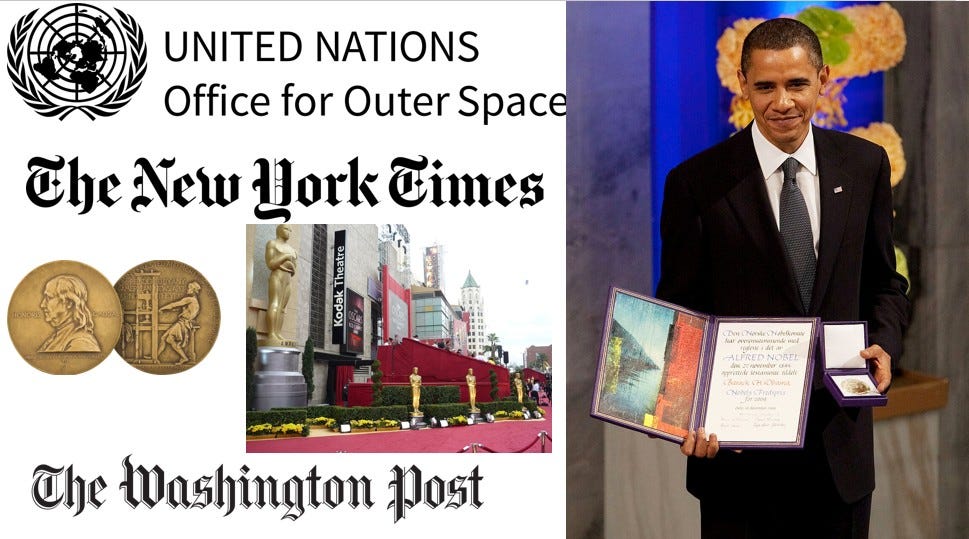
The United Nations
The New York Times, The Washington Post
The Pulitzer Prize, the Nobel Prize, the Academy Awards (Oscars)
They were each once widely respected and influential. They were each once largely independent. They’ve all become openly partisan. They’ve all lost respect and influence as their partisanship increased.
This is not about the merits of any of these organizations. The principle I want to explore here is this: Independence means little if you cannot maintain impartiality. Once bias seeps into an organization, it will lose credibility.
It is thus more valuable to focus on impartiality over independence. This is as true for individuals as it is for institutions.
Credibility creates influence
Whom do you trust in this world? Which people, publications, and organizations do you consider credible? Your first instinct might be to say you trust precious few.
We would never knowingly spend time with, or money on, people and companies we think are trying to harm us, right? The corollary is that when we do spend time and money, we assume our counterparts are at least neutral, if not downright favorable to our interests.
Deeper reflection suggests that we implicitly trust more sources than we might think, which gives them influence over our thoughts and our lives:
Any publication or media we subscribe to and regularly read (newspapers, YouTube, blogs, Instagram, Facebook, etc.). More details on this dynamic below.
The drivers of the bus, train, or Uber that we ride, and the pilots of the airplanes we enter. Statistically, the most dangerous part of anyone’s trip is when they step into a taxi or Uber, no matter what country they travel to.
The banks and financial institutions where we deposit our paychecks and keep our investments. We trust that our money is there and that we can access it anytime we want.
The police officers, lawyers, judges, and others who support and enforce the rule of law. We trust that our contracts will be honored, that the authorities will protect our property, and that criminals will suffer consequences.
The teachers who spend more time with our kids than we do. We trust that they have our kids’ best interests at heart and will not abuse our children, physically or mentally.
The grocery stores that sell us food, and the countless suppliers who sell it to them. We trust that the food we eat will not harm us.
This is just a partial list, but I think you get the idea. Modern life requires us to place implicit trust in a host of counterparts. And for many years, that system worked well.
I believe we’re seeing an unprecedented erosion of trust, caused by the institutions we implicitly trust losing their impartiality. I know it’s people in those institutions losing their impartiality, but we see the effect at the institutional level.

Partiality (bias) destroys influence
The content we regularly consume shapes our thoughts. (See The Information Diet.) There’s a reason we refer to online personalities as “influencers.” When journalists become partisan, no matter their reasons or good intentions, they risk losing readers’ trust.
I wrote about this recently (Why Beliefs Persist, and Why They Falter) and noted that Gallup polling showed fully 62% of Republicans have no trust that the mass media will report the news fully, accurately, and fairly. The figure has doubled in ten years. In contrast, only about 9% of Democrats lack all trust in mass media, largely unchanged over time.
This widening chasm in relative trust demonstrates bias. Regardless of one’s political beliefs, for purposes of our thesis, lost trust means diminished influence. A great swath of the country that once would have considered a New York Times article credible now reflexively dismisses it.
In institution after institution, neutrality has given way to partiality.
Social media outlets deplatform unpopular voices and shadowban or censor others. Partisans doxx and harass users expressing unpopular views.
Financial institutions cancel the accounts of politically sensitive individuals and industries.
Health authorities mislead the public about the efficacy of masks, vaccines, and other treatments. Pharma companies grow rich in finding new ways to make more people into forever customers.
University Presidents and Supreme Court Justices pretend to be unable to distinguish men from women for fear of antagonizing trans activists.
Teachers propagandize our children that our country is racist while failing in the basic mission to teach them reading and math.
Governments steer hundreds of billions of taxpayer dollars to unaccountable NGOs stuffed with cronies who pursue policies that voters did not approve.
I could go on, but again, I trust you get the point. I know some of you think the bad behavior all stopped once President Trump was re-elected. This is a dangerous fantasy. And it’s not how partisanship works.
If you seek credibility, maintain impartiality
When you find yourself having lost half your potential audience, don’t take comfort in gaining more partisans to your side. (New York Times)
When your largest financial backer starts to cut ties, don’t look to history or nostalgia to save you. (United Nations)
When two-thirds of your viewers no longer tune in, don’t consider yourself the same arbiters of culture you once were. (Academy Awards)
When you award prizes for national reporting based on hoaxes, don’t be surprised if people no longer listen to you. (Pulitzer Prize)
When you award peace prizes to leaders who create none and snub others who have, don’t be surprised if no one cares that you’re “independent.” (Nobel Peace Prize)
I get it. The urge to give in to partisan feelings is overwhelming. Not only does taking sides seem like the right thing to do, but it also seems necessary.
Even if you believe this, and perhaps especially if you believe this, don’t let your feelings blind you to the facts of what works. We must always check whether our actions lead to the desired results, no matter our intentions.
The evidence is heaping up that overt partiality is costing individuals and organizations their credibility. That means they lose influence, and hence effectiveness.
If one wants only to feel virtuous as their organization and their cause ignominiously fail, by all means, continue being partisan.
If, rather, we care about results, I say keep a cool head, stay above the fray, and above all, maintain impartiality.
Be well.
PS — I hope someone from the Federal Reserve is reading. There is no institution for which independence is more vaunted. And simultaneously, none is more likely to lose credibility by failing to stem partisanship impulses. What good is independence? Indeed.


James - You're a smart and clever man. You've written a partisan article about the dangers of partisanship, which I'm sure is a deliberate rhetorical strategy — presenting conservative cultural grievances in the more palatable language and institutional trust -- rather than a lack of self-awareness. Either way, your piece exemplifies its own thesis more than it argues it.
That said, your underlying argument — that impartiality is foundational to credibility — is genuinely sound and well taken.
What good is independence? Indeed.
Mic drop!
James, it sounds like you've lost all faith in many. I have to agree.
In fact, while reading this excellent treatise, I asked myself, where is any independence?
Not speaking for you, but I spend more time today asking if something is true, let alone if the source is unbiased. Sad commentary, and to think this has all happened within our lifetimes.
Thank you, sir. Carry on.